Aprilia Storm 125 officially launched at Rs 65,000

The Aprilia Storm started to reach dealerships a week ago, and after revealing the price on its social media, the manufacturer has officially launched the scooter at a price of Rs 65,000 (ex-showroom, India). The Storm was first displayed at Auto Expo 2018, and this production ready variant has undergone a few changes.

Unlike the Aprilia SRs that come with 14-inch wheels, the Storm features 12-inch alloy wheels and are of a simpler design than the ones we saw on the scooter at the Auto Expo.  It also misses out on a front disc brake and gets a drum brake at either end, with CBS. However, Aprilia has said that a disc brake variant is in the works. Other differences on the production scooter are minor, like the addition of a grab handle and a white Aprilia logo instead of a red one.

The Storm comes equipped with Vee rubber off-road-oriented tyres that measure 120/80 at the front and 130/80 at the rear. In comparison, the SR sports 120/70 section rubber at either end, and it recently switched from Vee Rubber to MRF Nylogrip Zappers. The scooter also features the bold graphics from the scooter displayed at the expo and will be availabe in two colour options.

The bodywork, instrumentation and lights, meanwhile, are identical to the SR 125. So is the engine -  it uses the same single-cylinder, three-valve air-cooled unit that makes 9.5hp at 7,250rpm and 9.9Nm of torque at 6,250rpm.

The Storm 125 costs around Rs 8,000 less than the SR 125 and In terms of competition, will take on TVS Entorq 125 (drum brake) that is priced much lower at Rs 58, 252 and the Honda Grazia (drum brake), which costs Rs 60,723 (both prices ex-showroom, Delhi).


from Autocar India http://bit.ly/2QGFEfn
via IFTTT

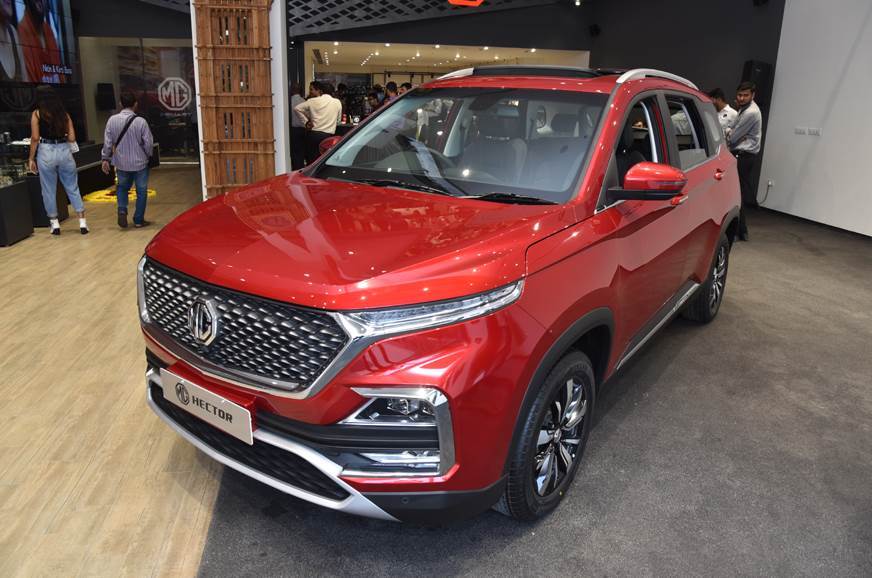
MG Hector bookings open officially on June 4, 2019

The MG Hector has made quite a splash, following its unveil on May 15, 2019. While a few dealers have been accepting orders prior to the model’s launch, MG Motor India has announced that Hector bookings will officially open on June 4, 2019. Incidentally, MG Motor India’s flagship outlet at New Delhi will also open its doors on that day; prospective buyers will be able book the SUV at 120 MG centres across 50 cities in India. Additionally, the SUV will also be available for booking on the carmaker’s India website, www.mgmotor.co.in, starting 12pm on the same day. 

MG had previously announced plans to widen its footprint in India, with 250 touch points to come up by September this year. Dealer despatches of the MG Hector SUV are expected to begin soon, with the market launch and price announcement expected to take place sometime mid-June 2019.

The MG SUV will come with a 143hp, 1.5-litre turbo-petrol; a 170hp, 2.0-litre diesel; and a 48V mild-hybrid version of the 1.5 turbo-petrol unit.  The 4,655mm long Hector will launch in five-seat form and 
MG has officially confirmed to us that a seven-seat variant will join the line-up in 2020.

The MG Hector will rival the likes of the Mahindra XUV500, Jeep Compass and the Tata Harrier.  The SUV will come with a long list of segment-first features, including a 10.4-inch portrait-oriented touchscreen infotainment system with a number of connectivity technologies, a panoramic sunroof, six airbags, and 17-inch alloy wheels, among others. MG Hector prices are expected to range from Rs 15-20 lakh (ex-showroom).     

MG Motor India is also readying its second product for our market, the eZS electric SUV, which will launch later this year.


from Autocar India http://bit.ly/2EGsYjA
via IFTTT

Production-spec Kia SP2i spied fully undisguised

There’s less than a month to go for the global debut of the Kia SP2i, which is set to take place on June 20, 2019. However, you won’t have to wait that long, as the production-spec Kia SP SUV has been spotted fully undisguised during a TV commercial shoot abroad, and the new spy pictures reveal a few key details.

First, the name. While the Kia SP spied in these pictures bears the Seltos name, it could have a different name for India. Kia is understood to have readied region-specific versions of the SP, and while Kia may christen it the Seltos for certain markets abroad, in India, it could be named the Kia Trailster.

As expected, the production-spec Kia SP2i remains largely similar to the SP Signature concept (revealed at the 2019 Seoul motor show) in terms of design. Replacing the Signature’s small, fancy-looking ORVMs are bigger units, and the 19-inch alloy wheels have made way for 18-inch wheels wrapped in 225/45-section Kumho tyres, even though the design of the dual-tone alloys remains the same.

Taking pride of place up front is the bold ‘Tiger Nose’ grille sitting between sharp-looking LED headlights, seemingly connected by a LED light bar atop the grille. The Kia Seltos sports a contrast roof, slim LED fog lamps, pull-type door handles, a chrome strip on the A-pillar, a chrome-finished window line that rises sharply towards the rear, prominent roof rails and a chunkier chrome bar connecting the mildly reshaped tail-lights.

Another interesting point to note is that the Kia Seltos seen in these pictures sports the T-GDi and 4WD badges, which indicates there will be a turbo-petrol, four-wheel drive version on offer in some markets. One of the interior sketches Kia revealed recently showed off what looked like a drive mode selector with ‘Off-Road’ marked on top of the dial, which indicates the Kia SP2i will also have a certain degree of off-road ability.

The spy pictures don’t reveal much of the Kia Seltos’ interior, but one shot does show the black-and-brown colour scheme on the inside. The Kia SP2i’s interior is expected to be well-appointed and will get a handful of segment-first features as well. Equipment on offer is likely to include a large touchscreen infotainment system, a 360-degree camera, wireless charging and in-car WiFi. A head-up display and an ambient lighting package will also likely be on offer on the top-spec variant.

At launch, the Kia SP2i’s engine options are expected to include a 1.5-litre petrol and a 1.5-litre diesel engine. Both engine options are likely to be BS6-ready, but could be BS4-compliant at launch. Both engines will be available with a choice of manual and automatic gearboxes, and Kia is even working on a sportier variant of the SP SUV, with a 140hp, 1.4-litre turbo-petrol engine paired to a 7-speed dual-clutch automatic gearbox with paddleshifters.

When it is launched in the months following its India reveal, the Kia SP’s price will be in the range of Rs 10-16 lakh (ex-showroom). At that price point, the SP will rival the Hyundai Creta, Nissan Kicks, Renault Captur, Tata Harrier, and even the lower variants of the Jeep Compass and the upcoming MG Hector.

What do you think of the Kia Seltos’ looks? Let us know in the comments.

Click here for more Kia SP pictures, details and info

IMAGE SOURCE: Chris Doane Automotive via Autoblog


from Autocar India http://bit.ly/2EJQ5tw
via IFTTT

Ferrari SF90 Stradale breaks cover

Ferrari has taken the wraps off the most powerful, most advanced and fastest-accelerating road car it has ever produced: the SF90 Stradale.

The new flagship Ferrari is also the first series production plug-in hybrid vehicle from the brand. It's the second of five new models to be presented this year – an “unprecedented” product rollout, according to the Italian firm.

Dubbed Project 173 during development, the production name (SF90) is taken from the Ferrari’s 2019 Formula 1 car and is also a reference to 90 years since Scuderia Ferrari was founded. Unlike with the LaFerrari, production is limited only to the amount the firm can sell, with 2,000 customers from around the world lined up already.

The most significant number for the SF90 Stradale is 1,000. That's the total horsepower figure that the petrol-electric powertrain makes: about 36hp more than the LaFerrari's and the most of any road going Ferrari ever built.

The heart of the car is Ferrari’s award-winning ‘F154’ twin-turbocharged V8, bored out from the 3,902cc of the 488 Pista to 3,990cc.  The resulting output of the engine alone is 780hp, with 800Nm of torque at 6,000rpm. The new engine design – in which the turbocharger is mounted lower and the flywheel is smaller – results in a lower centre of gravity. The exhaust system also makes use of the super-alloy Inconel, instead of steel, to save weight. Ferrari claims a “fuller, richer” sound for the exhaust.  Complementing the V8 is a trio of electric motors – two mounted at the front and one mounted at the rear between the engine and gearbox that in combination provide all-wheel drive. All three generate a total of 220hp to make the 1,000hp total. They are powered by a relatively small (7.9kWh) lithium-ion battery pack that makes the SF90 Stradale capable of 25.7km of electric-only running at speeds of up to 135kph. The battery can be charged either by plugging it in (no charging time has been revealed) or using the engine as a generator.

The two power systems are channelled through a newly developed 8-speed dual-clutch automatic gearbox. It’s lighter and more compact than the outgoing 7-speed unit and promises an 8 percent reduction in fuel consumption in normal driving on the WLTP cycle. Shifts are also claimed to be 30 percent faster. The advancements also extend to the brakes, with Ferrari recording a 160-0kph stopping distance 2m shorter than the LaFerrari.

All of this results a 0-100kph time of 2.5sec, which is a record for a road-going Ferrari. Furthermore, 0-200kph takes 6.7sec, while the top speed (claimed not to be the main performance focus) is 342kph. Ferrari also says the new car pulls out a 64-metre lead from the LaFerrari in one lap around its Fiorano test track.

A new power mode selector, dubbed eManettino, provides four driving modes. eDrive keeps the engine switched off for as long as the battery lasts, while Hybrid is the default setting, balancing both power sources. Performance and Qualify add increasing levels of go-faster capability.

The SF90 Stradale’s exterior is designed to provide the optimum balance between maintaining the style, heritage and proportions of classic Ferraris and employing advanced aerodynamics.

Two bodystyles are available on the SF90 Stradale: the standard one and the Assetto Fiorano package, which is aimed at forgoing some comfort in the name of offering better track pace. It features a taller rear spoiler for increased downforce, a more stripped-out interior and bespoke carbonfibre detailing, resulting in a weight reduction of 30kg. It also gets Michelin Cup 2 tyres with a bespoke compound instead of the Pirelli P Zero tyres available on the standard car.

The SF90 Stradale's shorter overhangs – including a rear one that’s shorter than the front – have created a cab-forward layout that's said to emphasise the mid-engined look and feel. The cabin area is 20mm lower than on previous Ferraris and is bubble-shaped with larger rear flying buttresses – a classic Ferrari design cue. Slim C-shape headlights are integrated in the brake air intakes and use matrix LED technology, while the tail-pipes are centrally mounted and higher than ever before.

Ferrari claims the SF90 Stradale is “the new benchmark for downforce and efficiency in high-performance road cars”. The headline figure is 390kg of downforce generated at 250kph – 30kg more than the LaFerrari.

The stand-out bodywork element is a part of the rear wing. Dubbed the ‘shut-off Gurney’, it’s a mobile section of the spoiler that, in high-downforce conditions, is lowered towards the body to create new tail geometry, or raised up when low drag is needed for straight-line speed. A complex system of vortex generators and two front diffusers ensure airflow from the front to the rear is optimised.

As with the rest of the car, the SF90 Stradale’s interior is totally new. Even entering it is a different process, with a new keyless entry system incorporating a key that is shaped and styled like the Ferrari logo and doors that open via push buttons from the inside.

The dashboard is dominated by a completely new interface and a 16-inch curved digital instrument cluster. All car functions and infotainment are controlled through this, with only a handful of touch-sensitive icons on either side of the steering wheel for climate and driving assistance functions.

A head-up display also features for the first time, but it’s the new steering wheel that's most significant. Ferrari claims 80 percent of the car’s functions can be controlled from here, citing that “eyes on the road, hands on the wheel” was a key safety motivation during development.

Despite the technological advances, a few classic touches still remain, including the gear selections built into an ‘H-gate’-style metal gear lever.

Ferrari is remaining coy about the exact pricing figure for the SF90 Stradale, claiming it will be revealed later.

The car is a series production model, with of the 2,000 customers who are invited to see the car, “most have already ordered one. Anyone who orders now will have a long wait” according to sources.   The first deliveries are tipped to begin in Italy in the first quarter of 2020.

Also see:

2020 Ferrari SF90 Stradale hybrid image gallery

Click here for Ferrari India models, prices, reviews, features, videos, images and more


from Autocar India http://bit.ly/2WanjNw
via IFTTT

Sponsored Feature: Hometown Hero - Mango Run in a Renault Duster

Sometimes, familiar roads lead to new destinations and to new perspectives. If that sounds a touch philosophical, let me elaborate. I am, as I suppose you all are, a massive mango fan, and when I say mango, I mean the Alphonso or Hapus. I could write a thesis on them, and I always believed that there was the Alphonso, and there were the rest.

That was until earlier this year when a Goan friend of mine asked me whether I had ever tasted the Mankurad. He rubbished the Alphonso, and called it a poor cousin of the Mankurad. My curiosity was piqued, and as luck would have it, I was asked to head out in a Renault Duster AMT for the first leg of our mango run to, of all places, Goa. So, there I was last month, pointing the Duster’s pugnacious nose down south. But what exactly is the Mankurad? And why is it that most mango lovers, especially those in Mumbai,  have never heard of it? The Mankurad is grown in Goa, and it is in such demand in the tiny state that it is rarely seen in other parts of the country. The name, apparently, is a corruption of the Portuguese Malcorado (poor in colour), but, as my friend pointed out, the mangoes have an intense aroma and burst with flavour. I might have been curious, but I was still a sceptic, and I carried that scepticism all through our journey, which began on a steaming Wednesday morning.

Old roads, new journeys

I can never tire of going to Goa, and the windows of the Duster framed familiar yet soothing sights – trees in full bloom in summer, makeshift neera stalls by the roadside, and hundreds of cars packed with happy families off on their holiday. I was also glad that I was in a car I was familiar with. It’s been about seven years since Renault launched it here, and it’s had a recent update making it as indefatigable as ever. The variant I was driving was the AMT, which is basically a 6-speed automated manual transmission mated to the doughty 110hp motor. Like all automatics, the AMT is supposed to make driving in the rotting traffic of cities less of a chore, which it does, of course. But, as importantly, I found it to be a good companion on highways as well. With its happy and powerful diesel, and the tall sixth gearing that made for great cruising, we munched the miles from Mumbai to Goa and hit the sun-kissed state earlier than we expected to. Also impressive was the Duster’s fuel efficiency. It returned a healthy 17kpl on our trip. In other words, I reached Goa with lots of fuel to spare. Here’s what I jotted down in my notepad on that evening by the beach – ‘Why doesn’t the Duster have a dead pedal?’ ‘Gearshifts mostly and pleasantly seamless’; ‘Prefer shifting manually around corners; thank god for manual mode’; and ‘Early morning meeting with Nestor Rangel at Valpoi’.

Nestor Rangel is a genial man in his late 30s. He is among those Goans who have taken it upon themselves to conserve the Mankurad mango and help popularise it. The cultivation of the Mankurad is not as popular as other more established mango varieties, and one of the main reasons is that it does not travel well. Rangel owns several mango orchards in Valpoi, which is about 40km from Panaji, and among the mangoes he grows there is the Mankurad. Before driving to Valpoi, I hit the fruit markets around Mapusa to check out the object that had made me drive this far. The Mankurad looks a lot like the Alphonso mango, though it feels a lot fleshier. But its aroma is distinct and a touch heavier than its more famous neighbour. And it wafted through the Duster’s cabin, as we drove towards Valpoi, flicking the car into narrow lanes, deftly negotiating a late morning surge in traffic, and riding roughshod over some especially rough patches of road. The AMT was a boon in and around chaotic Panaji, and as I switched to the highway and floored the pedal, the Duster stayed reassuringly stable even at triple-digit speeds, just like it did on our way from Mumbai to Goa.

King of mangoes

Rangel smiles a lot when he talks about the Mankurad. You can see he is intensely passionate about this mango variety. He tells me that most farmers in Goa grow the mango variety organically and they do it out of passion. “Its short shelf life means export and even long-distance transportation within the country is an issue. Again, we avoid pesticides and hybrid ripening. That means it ripens naturally, and that is responsible for its distinct taste,” says Rangel.

Mangoes grown in Goa were always much sought after, especially after the arrival of the Portuguese into the region. The Portuguese popularised modern grafting techniques, and soon enough the reputation of its mangoes spread all over the world. Apart from the Mankurad, the other mangoes that are much in demand include the Hilario, Fernandin, Xavier and Monserrate.

Desa, a Goan based in Qatar, is another Mankurad aficionado. In early May, Desa, along with fellow Mankurad lovers who form part of Transform Goa, an NGO, organised the second edition of the All Goa Mankurad Festival. “I have eaten mangoes from all over the world, and there is nothing like the Mankurad,” says Desa, echoing what every Goan fervently believes. Desa says that 20 vendors participated in the most recent edition of the festival, and over 1,000 people turned up to both buy the mangoes and express their solidarity. With support from the state government, Transform Goa plans to introduce Mankurad to the world. “We will encourage private land owners to plant saplings, create a cooperative movement. In April and May, all roads in Goa should give out the aroma of the mango, and this can be achieved by planting the mangoes along the roads in the state,” says Desa. Plans are also afoot to involve the Central Coastal Agricultural Research Institute, in Goa, which, Desa hopes, will help Mankurad enthusiasts get the hang of better grafting techniques.

Sweet surrender

Rangel gifted me some Mankurad mangoes, and I purchased more from the markets around Mapusa. Mankurad sells for about the same price as Alphonsos in Goa, for about Rs 400-Rs 600 a dozen, and the price is only slightly negotiable, if at all. Obviously, vendors know they will always find buyers for the Mankurad. The Duster’s commodious boot easily swallowed up the dozens of mangoes I purchased, and I made my way back to Mumbai early next day. Once back home, late at night, I sliced open a Mankurad and bit into it. The first thing that hits you is the flavour: it is indescribably rich, and combined with that distinctive aroma, it creates a delightful impression on your palate. It is almost as sweet as the Alphonso, and definitely way juicier. I didn’t stop at one. In fact, after consuming about three, I realised that unlike Alphonsos, which taste more or less the same, each Mankurad tastes slightly different from the other. There is no monotony of taste, so to speak. Does that mean that the Mankurad is my new favourite? Not yet, but it might soon get there. 


from Autocar India http://bit.ly/2Md7gtB
via IFTTT

PhotoGallery: 2020 Ferrari SF90 Stradale Hybrid image gallery


from Autocar India http://bit.ly/2WrmejR
via IFTTT

Sponsored feature: The weekend explorer

On One of these weekends, just before the skies open up, get out of home early, start your car, and see Mumbai city with fresh eyes. It is a more enjoyable activity than you’d think (after all, how many weekends will you sleep in?) and if you have a car like the Hyundai Creta, you and your family have the perfect steed to introduce you to things you probably didn’t know about your city. This is what we did last month in our Hyundai Creta, which is equipped with a 1.6 CRDI with a variable geometry turbocharger. Here is how it went.

Parks and recreation

How long have you been living in Mumbai, and how many times have you visited the Sanjay Gandhi National Park (SGNP) in Borivali? Well, irrespective of how many times you’ve actually been there, the point is that you should be doing it more often.

Why? Here’s one fundamental reason: SGNP, which covers over 100 sq km, is the largest park in the world that is located within a city’s limits – but wait, there’s more. Not only is it huge, it contains Vihar and Tulsi lakes, which contribute significantly to the city’s water requirements; and it is also home to the Kanheri Caves, which are ancient Buddhist monasteries cut into rock faces and located about 6km from the main entrance to the park. Obviously, there is a variety of flora and fauna in there as well, including lions and tigers (housed in separate parts of the park), leopards, of course, and colourful birds as well.

As you drive towards the park, along a narrow road lined with trees on both sides, what will stand out is the silence. And you’ll wonder: How you put up with Mumbai’s cacophony, day in and day out? The Creta is a good companion to have in the park. It might have a powerful diesel engine, but it’s very refined and quiet, and the engine pulls the car along nicely. With the wide torque band – max torque in the Creta is produced at 1,500-3,000rpm – travellers can coast comfortably and quietly all the way to SGNP’s parking lot, from where one switches over to safari buses.

Rock of ages

Gilbert Hill, in Andheri, is about 65 million years old. It was formed during the Mesozoic era and is a vertical column of black basalt that shot up from under the Earth’s surface during periods of volatile volcanic activity. Today, the 200ft Hill is surrounded by slums and residential complexes; and chances are you might have to negotiate challenging traffic as you make your way towards it. Thankfully, the Creta has a handle on such stuff. It is extremely adept at negotiating the urban environment. That includes Mumbai’s roads, which often feature the most exasperating undulations. Although the Creta’s suspension sorts them out with aplomb. The steering is light, so you can flick the car in and out of tight situations. The strong mid-range comes in handy while performing quick overtaking manoeuvres; and the 6-speed gearbox is a joy to use. What adds to the special feeling of driving just the right car are the features the Creta is loaded with: an electric sunroof, a powered driver’s seat, cruise control, wireless phone charging, and a dedicated app that tracks driving patterns and vehicle health.

Gilbert Hill is widely believed to be one of the three oldest structures in the world, and thankfully (in a city where unscrupulous builders prey on every available piece of land) is a protected Grade II heritage structure. The other two ancient geological structures are in the US.

Right at the top of the hill are two temples, each dedicated to Hanuman and Gaondevi Durga, respectively. Get out of the car, crane your neck, and gaze in wonder at the hill which would have been witness to the rise of humanity; and as you start to walk back to your car, reflect on how far we have come since then.

Art Dekko

You’ve probably driven on Marine Drive a zillion times, and gazed at the buildings along the waterfront, from Nariman Point to Chowpatty. They are elegant all right, but did you know that they are very special? Mumbai has the world’s second-largest collection of Art Deco buildings, after Miami.

But first: what is Art Deco? Art Deco was a movement in the visual arts and architecture born in France in the 1920s, and was popular in both western Europe and the US, right until the mid-1930s. Among other things, Art Deco was characterised by geometrics, visual drama and bold colours. Mumbai, which was then India’s commercial hub (as it is now), embraced Art Deco and made it its own. In a way, the modernist architectural style represented the city’s aspirations. Besides Marine Drive, one can find Art Deco buildings in other parts of south Mumbai, and these buildings include theatres – Eros, Liberty, Regal, Metro – commercial establishments and hospitals.

Taking a tour of the Art Deco precincts of the city was great fun in the Creta. Marine Drive, as always, gave the car an opportunity to stretch its legs. Since we are talking about speed, it would be prudent to mention that the car is also equipped with ABS, ESC, and six airbags.

Steps this way

The Town Hall, which houses the Asiatic Society of Mumbai, is one of the city’s oldest libraries and probably has the most famous steps in Mumbai. With its pedimented portico with eight Doric columns, cosy chairs in the ‘periodicals’ room, and the grand Durbar Hall, the building, which was constructed in 1830, is home to over 1,00,000 books, as well as coins, relics, periodicals and manuscripts. Among the books is an original Italian manuscript of Dante’s Divine Comedy. If you happen to reach there early enough – the library shuts at 6:30pm – enquire and make a note about membership details, and ensure you sign up soon enough. Once you’ve done that, drive around the Fort area, where the library is located. Drop into one of its many popular restaurants – Ideal CafĂ©, for instance – and treat yourself and your family to an excellent dinner. The drive back home awaits, but it’s been a good day, as it always is when you are in a Creta.


from Autocar India http://bit.ly/2WufktV
via IFTTT

MG Hector gathers 50,000 bookings

MG Motor India has announced that its first product for our market, the Hector SUV, has crossed 50,000 bookings. The model was launched las...